The Future of AI in Nigerian SMEs
Running a small business in Nigeria has never been easy. Between erratic power supply, rising costs, and the daily struggle to attract and keep customers, many entrepreneurs feel like they are constantly putting out fires. The numbers paint a sobering picture: over 50% of Nigerian MSMEs fail within their first year, and more than 95% collapse within five years. A staggering N13 trillion financing gap exists, and 78% of enterprises say financial limitations are their biggest obstacle.
But buried within these challenges lies an extraordinary opportunity. Artificial Intelligence (AI) is no longer a tool reserved for Silicon Valley tech giants. From a bustling supermarket in Lagos to a small retailer in Kano, AI tools are quietly helping Nigerian SMEs cut costs, serve customers faster, and compete with much larger players. The AI future Nigeria is not a distant dream—it is already taking shape, one automated chatbot and one predictive inventory forecast at a time. This article walks you through practical, affordable ways to start your own AI journey, the real obstacles you will face, and the realistic outlook as Nigeria marches toward a digital‑first economy by 2030.
Why Nigerian SMEs Need AI Now
Nigeria is home to over 39 million small and medium enterprises. Together, they contribute nearly half of the country’s GDP and employ the vast majority of Nigerians. Yet, survival rates remain dangerously low. Poor record‑keeping, guesswork in pricing, slow customer service, and inefficient inventory management silently drain profits month after month.
This is where AI becomes a game‑changer. According to a nationwide survey of over 5,000 SMEs, awareness of AI is rising, but actual adoption is still minimal in sectors like agriculture, fashion, and traditional manufacturing. That gap between knowing and doing is where smart entrepreneurs can seize an advantage. Businesses that integrate artificial intelligence adoption into their daily operations report roughly 32% higher efficiency and noticeable revenue growth.
More importantly, AI helps SMEs move from reactive firefighting to proactive decision‑making. Instead of wondering whether next month’s demand will rise or fall, predictive analytics for small business can forecast sales based on historical data. Instead of losing customers to slow replies, AI‑driven customer service ensures instant responses, even at 2 a.m. For a small business in a cash‑tight economy, these improvements are not luxuries—they are survival mechanisms.
Practical AI Applications for Small Businesses
AI might sound intimidating, but most tools available today are designed to work on ordinary smartphones, integrate with WhatsApp, and require zero coding skills. Here are four high‑impact areas where Nigerian SMEs are already winning.
1. Customer Service That Never Sleeps
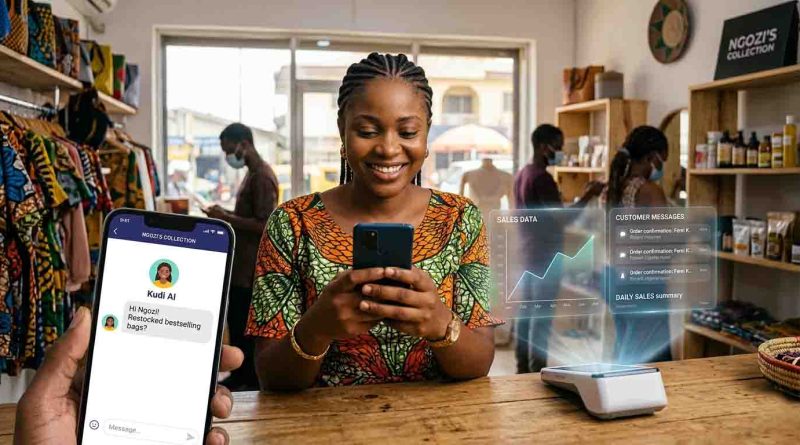
Nigerian customers prefer to send messages rather than call. That makes WhatsApp one of the busiest business channels in the country. AI chatbots can answer FAQs, check order status, and guide customers—all without human intervention. A supermarket owner in Lagos recently shared how her WhatsApp bot handles over 300 customer messages weekly, allowing her staff to focus on stocking and sales.
2. Smarter Inventory and Pricing
One of the biggest profit killers for retailers is overstocking slow items while running out of bestsellers. Predictive analytics for small business can reduce dead inventory by up to 25%, freeing up cash flow. Nigerian retailers are already using predictive tools to align inventory with demand, cutting waste and keeping customers happy.
3. Automated Finance and Admin Work
Manually tracking expenses, generating invoices, and preparing for tax season is a nightmare for any business owner. AI‑powered bookkeeping apps now detect duplicate payments, highlight suspicious transactions, and keep financial records tidy. Some are simple enough to install on a regular smartphone and reduce admin workload by 30% or more.
4. Marketing Without Breaking the Bank
Creating fresh content daily for Instagram, TikTok, or Facebook used to require hiring a designer. Today, AI tools generate social media captions, product descriptions, flyers, and short ad scripts in minutes. A fashion store in Yaba tripled its engagement within two months by posting daily content generated with AI, without paying for freelance designers each week.
| Business Task | Traditional Approach | AI‑Powered Solution | Typical Benefit |
|---|---|---|---|
| Customer inquiries | Hire extra staff or leave unanswered | WhatsApp chatbot that works 24/7 | Instant replies, lower labour cost |
| Inventory management | Manual stock counts, gut feeling | Predictive analytics forecasting | Up to 25% less dead stock |
| Bookkeeping | Spreadsheets or paper records | Automated AI accounting apps | 30% less admin time, fewer errors |
| Social media marketing | Agency or freelance designer | AI content generation tools | Daily fresh posts at near‑zero cost |
Overcoming Barriers to AI Adoption
Despite the clear benefits, many SME owners hesitate. The three most common barriers—cost, skills, and infrastructure—are real, but they are no longer insurmountable.
Cost. The biggest myth is that AI is expensive. In reality, most AI tools in 2026 cost less than hiring a single junior staff member. Some are free, and many only charge for the features you use. Cloud computing and open‑source frameworks like TensorFlow have removed licensing barriers, converting fixed investment into variable cost. For Nigerian SMEs, this means you can start with a zero‑cost chatbot and scale up only as you see results.
Skills. You do not need to become a data scientist. Many local startups are building cost‑effective AI solutions that work right out of the box. Timart, for example, offers an AI‑powered WhatsApp assistant that lets shop owners record expenses and track sales by simply sending a chat message. Quantum AI Solutions has built Scribex, Africa’s first locally deployed AI document workstation that runs on a private network with no cloud dependency—perfect for Nigerian SME environments where connectivity is inconsistent and budgets are tight.
Infrastructure. Power and internet challenges are real. But the new wave of local AI tools is designed with offline‑first features. Timart’s offline‑first capabilities work perfectly in areas with poor connectivity. Moreover, Nigeria’s National AI Strategy, backed by NITDA, aims to achieve 95% digital literacy and build resilient digital infrastructure by 2030. The government is piloting AI applications in healthcare, agriculture, education, and financial inclusion, which will gradually improve the ecosystem for SMEs.
Realistic Outlook – The AI future Nigeria by 2030
Looking ahead, the future of AI in Nigeria is poised for remarkable growth. The global AI economy is projected to reach 15.7trillionby2030,andNigeriaaimstoclaimameaningfulshare[reference:18].Thecountry’sNationalAIStrategytargetsa15 billion contribution to GDP by 2030, with AI skills for 70% of the young workforce and a 27% annual market expansion rate.
By 2030, you can expect:
- Ubiquitous AI assistants that understand local languages and business contexts, not just English.
- Predictive analytics integrated into everyday POS systems, helping every retailer forecast demand automatically.
- AI‑powered logistics that optimise delivery routes in real time, slashing fuel costs and delivery delays.
- Automated financial tools that handle tax compliance, payroll, and credit scoring without human intervention.
- Digital literacy as a basic requirement, with NITDA’s goal of 95% digital literacy by 2030 creating a workforce that is AI‑ready.
However, this optimistic outlook depends on urgent action today. Over 60 million Nigerians remain offline, and the digital divide could leave many SMEs behind if access is not expanded. Stakeholders at the 2025 AI Forum Nigeria have urged businesses to move beyond pilot projects and adopt AI‑first structures across their operations. The path forward is clear: start small, focus on one problem at a time, and scale what works.
Conclusion
The future of AI in Nigeria is not a far‑off fantasy. It is a practical, affordable, and increasingly essential toolkit that can help your SME survive, compete, and grow. Whether you run a small retail shop in Aba, a catering business in Abuja, or a fashion boutique in Lagos, AI can cut your costs, free up your time, and help you serve customers better.
You do not need a huge budget or a degree in computer science. Start with a free WhatsApp chatbot. Try an automated bookkeeping app. Use a simple AI content generator for your social media. Each small step builds your operational efficiency and gets you ready for the digital transformation Nigeria is already undergoing.
The window of opportunity is open. The tools are ready. The only question is: when will you take your first step into the AI‑driven future?