
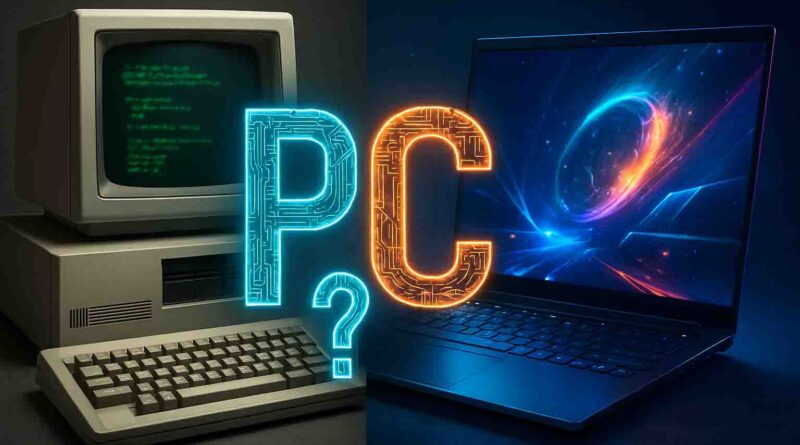
What Does PC Stand For? | Full Meaning Explained
In everyday conversation, “PC” is one of those ubiquitous terms we often use without a second thought. Yet, its meaning is both specific and surprisingly fluid, having evolved in tandem with the technology it describes. So, what does PC stand for? At its most fundamental, PC is an acronym for Personal Computer—a device designed for individual use, as opposed to the room-sized mainframes and minicomputers used by multiple people through terminals.
This article will explore the full form of PC, trace its fascinating history, and examine how its definition has expanded and adapted in our modern device-filled world.
The Core Meaning: Unpacking “Personal Computer”
The full form of PC, “Personal Computer,” encapsulates a revolutionary idea: computing power accessible to a single person, for personal or professional tasks. This distinguishes it from shared, institutional computing systems. Key characteristics that originally defined a personal computer include:
- Ownership and Control: Dedicated to one primary user.
- General-Purpose Design: Capable of running various software for productivity, creativity, and entertainment.
- Standalone Operation: Contains all necessary components (processor, memory, storage) within its form factor.
- Interactive Interface: Utilizes a direct input method (keyboard, mouse) and output display.
This concept of individualized computing was the seismic shift that brought technology into homes and small businesses, forever changing how we work, learn, and connect.
Historical Context: The Birth of the Personal Computer
To appreciate what the term “PC” signifies today, understanding its origins is essential. The journey began in the 1970s with early microcomputers, such as the Altair 8800, and popular kits. However, the concept truly entered the public consciousness with the arrival of user-friendly, pre-assembled machines.
The late 1970s and early 1980s saw the launch of iconic devices such as the Apple II, the Commodore 64, and the IBM PC 5150. It was IBM’s entry in 1981 that profoundly cemented the term “PC” in the cultural lexicon. The open architecture of the IBM PC led to widespread cloning by other manufacturers. These “IBM PC Compatibles” overwhelmingly used the Microsoft MS-DOS (and later Windows) operating system and Intel-style processors.
During this era, what does PC stand for in the marketplace? It came to specifically denote this ecosystem of IBM-compatible computers running DOS/Windows, setting them apart from competitors like Apple’s Macintosh. Thus, the term developed a dual meaning: the broad category of all personal computers and the specific lineage of Windows-based machines.
Evolution and Expansion of the Term “PC”
As technology advanced, so did the shapes, capabilities, and competitors within the personal computing space. The meaning of “PC” had to stretch to accommodate these changes.
- The Apple Rivalry (PC vs. Mac): A significant evolution in terminology was the industry and marketing distinction between “PCs” (Windows-based machines) and “Macs” (Apple’s computers). This usage is still prevalent, though technically, both are personal computers.
- The Rise of Portability: Laptops, and later notebooks and ultrabooks, challenged the traditional desktop-centric image. These mobile, all-in-one form factors were unequivocally personal computers, proving that high performance no longer required a bulky tower.
- The Modern Ecosystem: Today, the family of computers includes diverse members. While traditional desktops and laptops remain core, the term “PC” now often encompasses powerful gaming rigs, compact mini PCs, and even 2-in-1 convertibles that blur the line with tablets. The core idea remains a device with a fully-featured desktop operating system (like Windows or Linux) capable of running generalized, installable software.
The PC Today: Relevance in an Age of Mobile Devices
In a world dominated by smartphones and tablets, one might question the ongoing relevance of the PC. However, its role has simply specialized. Mobile devices excel at consumption, communication, and on-the-go tasks, but the personal computer remains the unrivaled tool for complex creation, deep analysis, and intensive workloads.
Modern PCs are defined by their power and versatility. They are essential for:
- Content Creation: Video editing, graphic design, and music production.
- Software Development: Coding and programming.
- High-Performance Gaming: Demanding titles with advanced graphics.
- Data Analysis and Scientific Computing: Handling large datasets.
- Specialized Enterprise Applications: From architecture to financial modeling.
The form factor continues to evolve, but the core principle of a powerful, general-purpose tool under individual control remains intact. The market for high-performance PCs, in particular, continues to grow, underscoring their enduring value.
Also Read, How to Reset Windows 10 Password Without Logging In
Conclusion
What does PC stand for? It stands for a transformative idea that democratized computing: the Personal Computer. From its early days as a niche hobbyist machine to its status as a specific brand of IBM-compatible hardware, and now to its current identity as a versatile powerhouse in an ecosystem of mobile devices, the term “PC” has proven remarkably adaptable.
It no longer refers to just one type of machine but to a category defined by capability and personal agency. Whether it’s a sleek laptop, a towering gaming desktop, or a compact workstation, the PC remains the foundational digital tool for serious work and play, continually adapting to meet the demands of the future while staying true to its personal roots.